
Welcome to the grand unveiling. My repository is functionally complete, at least as far as Phase One is concerned.
The first phase of this project is to replace the old rubygems.mill6.com site with the new gemz.mill6.com site. The former was based on a damaged open source gem called “geminabox”. As of Ruby version 3.3, it is broken, requiring me to run an older version of Ruby in its own sandbox to run the site. No thank you. Now that gemz.mill6.com is on-line and running, I can kill the other site and free up some server resources.
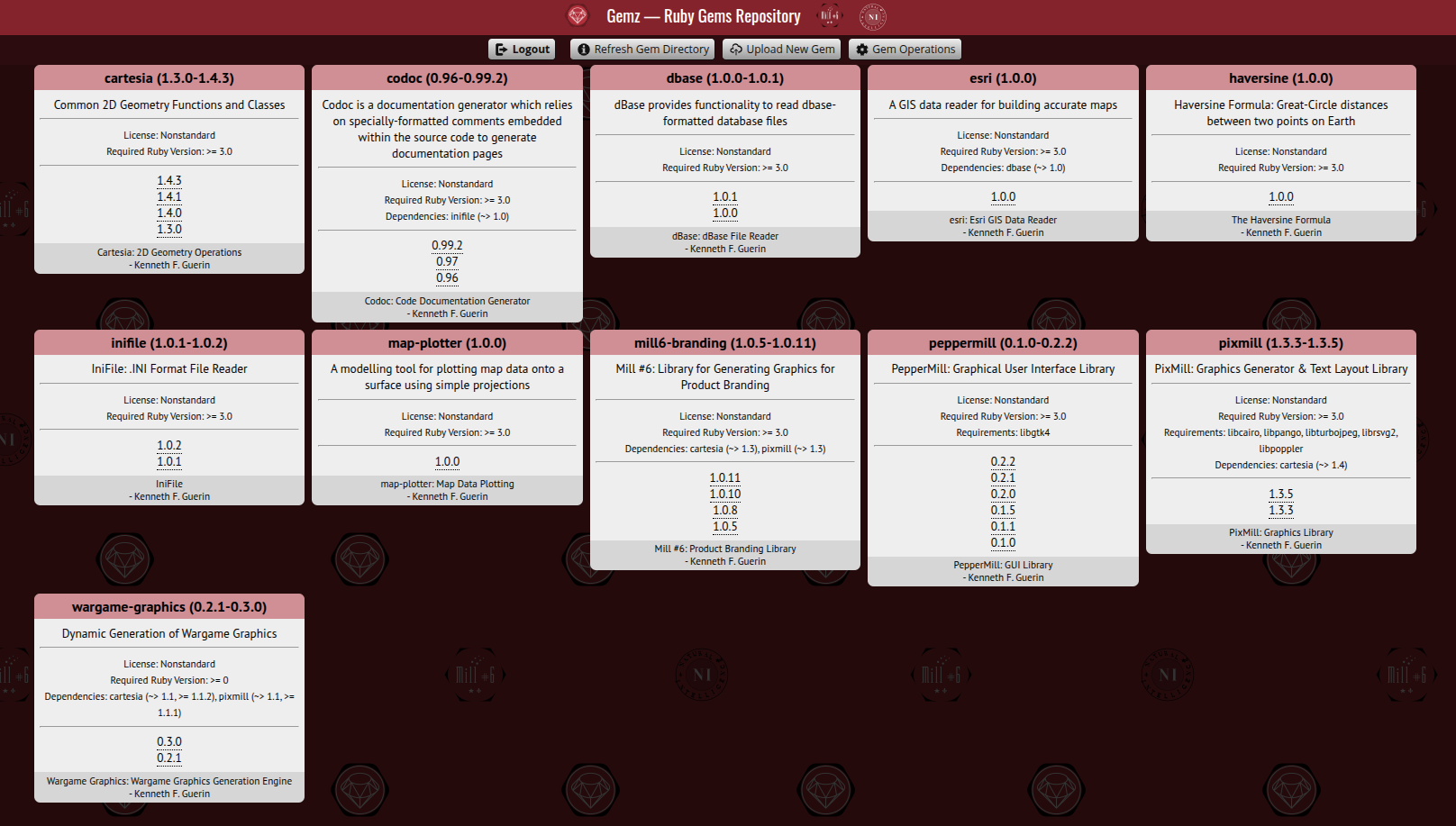
The featured image above is the active production site. It contains a collection of the gems that I have in my coding arsenal in various stages of development. The interesting ones are: codoc, pixmill and peppermill.
Codoc is a documentation generator which reads source code files and generates HTML documentation from them. A screenshot of my documentation site follows:
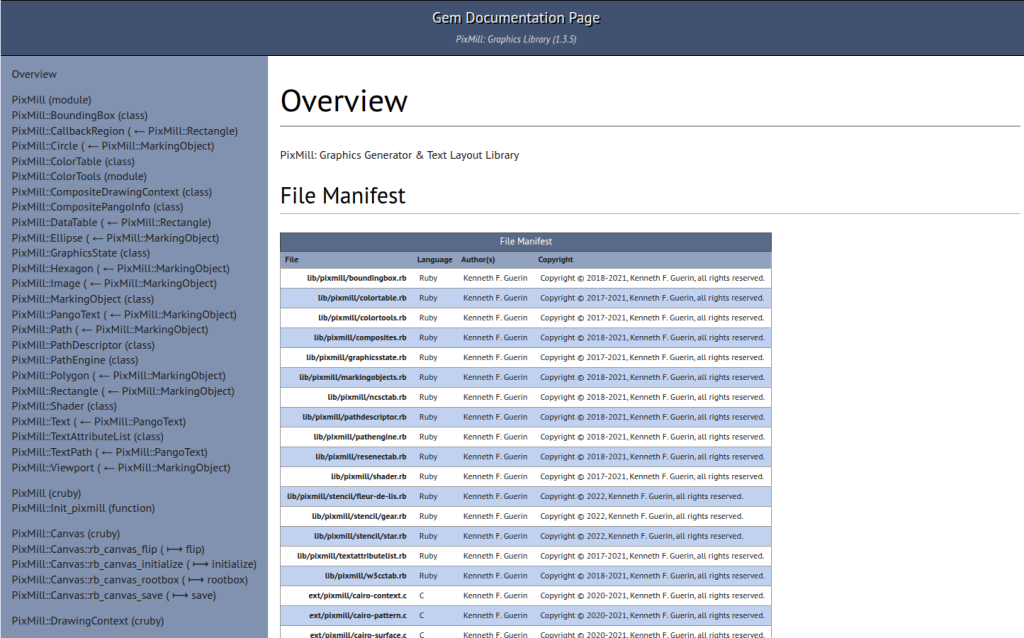
Unlike tools like doxygen or yardoc or others, the codoc library accepts and parses source code files in multiple languages and supports language-specific documentation tags, which, as you might glean from the PixMill file manifest, was a requirement of the project. For example, in Ruby, exceptions are raised while in Javascript, they are thrown. Therefore, Javascript functions which throw exceptions will be commented with a “throws” tag while Ruby methods which raise exceptions will be commented with a “raises” tag. Do they mean the same thing? Yes, but coders operating in a particular language should not have to reach for neutral or foreign terminology when writing documentation.
PixMill is my graphics generation tool. It can support reading from and writing to multiple graphics file formats and can create graphics on an empty canvas if need be. This library sits on top of a few open source graphics libraries that are part and parcel of the Linux and open source ecosystem, such as cairo and pango. Along with Cartesia, my 2D geometry library, numerous graphics objects can be drawn and stored. All of the icons that I’ve created, as well as the numerous wargame graphics I’ve built over the years, were built using this library.
PepperMill is my newest library and is in an early stage of development. It will enable GUI applications on macOS and Linux platforms (and probably Windows if WSL is installed). It will allow me to write Ruby scripts that aren’t tied to a command-line interface. The idea is to provide a common API that can work with the native subsystems provided by macOS (Cocoa) and Linux (Gtk) by hiding the details and mapping logical constructs. As of today, I can build scripts that support a main menu and can exit cleanly. There’s A LOT to do, but it’ll be fun work.